

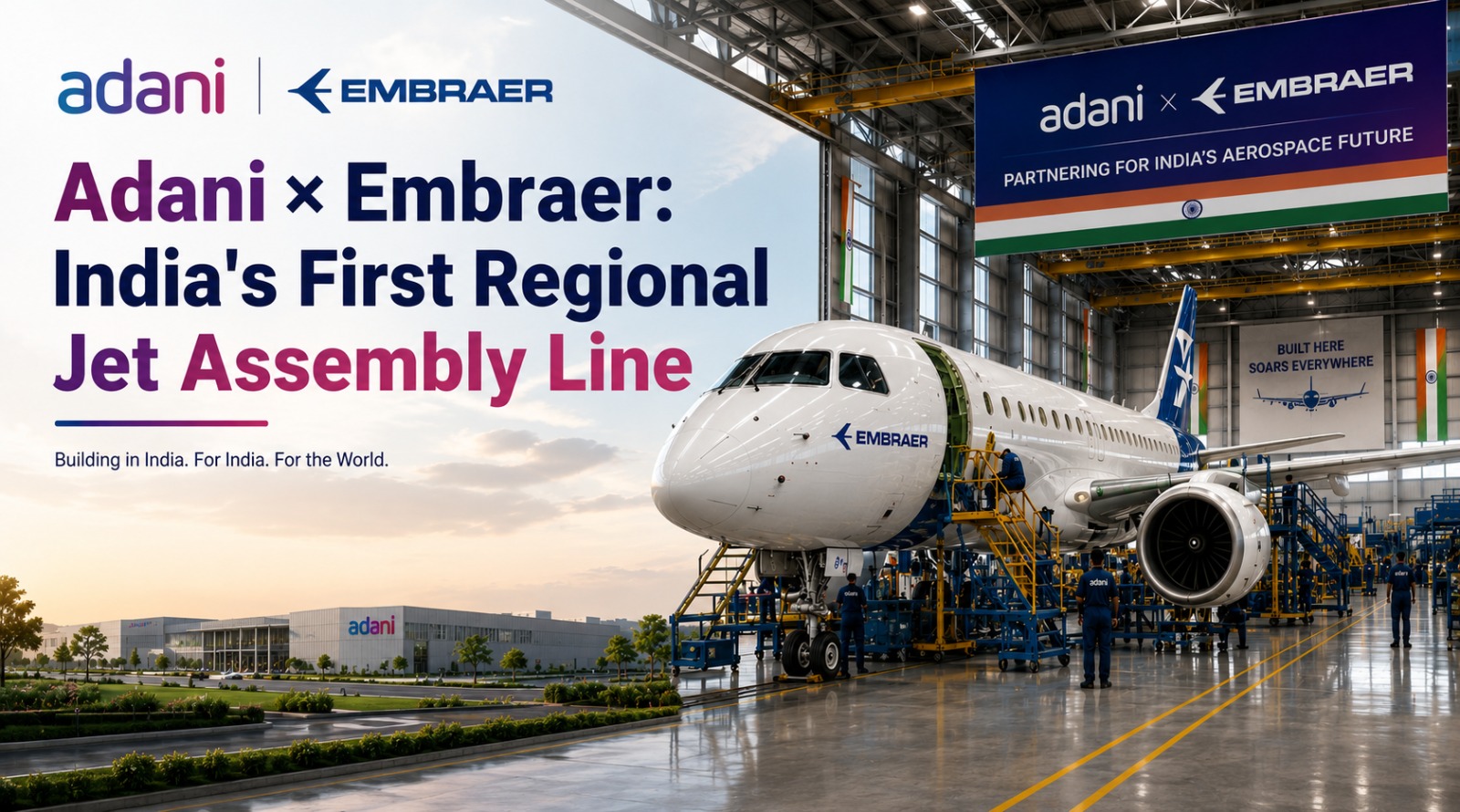
India’s Regional Aviation Ambition Takes Shape: Adani & Embraer Select Dholera for Final Assembly Line
A strategic joint venture between Adani Defence & Aerospace and Brazil’s Embraer
marks a pivotal moment for domestic aircraft manufacturing — and signals growing
investor interest in India’s aerospace value chain.
The Deal at a Glance
Adani Defence & Aerospace and Embraer inked a Memorandum of Understanding in January
2026, laying the groundwork for an integrated regional transport aircraft (RTA) ecosystem in
India. The agreement covers aircraft assembly, supply chain development, MRO (Maintenance,
Repair & Overhaul) services, and pilot training — positioning the partnership well beyond a
simple manufacturing contract.
The Dholera Special Investment Region (DSIR), near Ahmedabad, has now been confirmed as
the site for the Final Assembly Line (FAL). Dholera is being developed as a greenfield smart
industrial city — one of India’s most ambitious infrastructure projects — and will also house a
Dholera International Airport and dedicated MRO facilities, making it a natural fit for a vertically
integrated aerospace hub.
Why This Matters for Investors
India’s commercial aviation sector is on a structural growth trajectory. With over a billion people
and historically low air travel penetration, domestic passenger volumes are expected to multiply
over the next decade. Regional connectivity — linking Tier 2 and Tier 3 cities — is the single
largest untapped segment, and the UDAN scheme has been the policy catalyst.
The Adani–Embraer partnership is significant not merely as an assembly deal, but as the
beginning of a phased indigenisation programme. The ambition is to progressively increase
local content — from assembly to component manufacturing — building a domestic aerospace
supply chain that does not currently exist at scale in India.
“Regional aviation is the backbone of economic expansion. With initiatives like
UDAN transforming air connectivity across Tier 2 and Tier 3 cities, the need for an
indigenous regional aviation ecosystem has become critical.”
For Embraer, India represents its largest untapped market globally. The company already
operates approximately 50 aircraft across the IAF, government agencies, and commercial
carriers — including Star Air’s fleet of E175 and ERJ145 jets. A domestic FAL would
substantially reduce lead times, localise after-sales support, and improve commercial
competitiveness on Indian routes.
Key Risks and Considerations
As with any large-scale industrial partnership at this stage, investors should weigh several
factors before drawing conclusions on commercial impact.
Airline Order Dependency
Embraer CEO Arjan Meijer has stated clearly that the assembly line’s viability hinges on firm
commitments from Indian airlines. Without confirmed orders, the 2028 timeline may face
delays.
Revenue Complexity
regional routes remains a structural challenge for operators considering new fleet
commitments.
Supply Chain Buildout
Phased indigenisation is the stated goal — but developing a local aerospace supply chainrequires sustained investment, skilled labour pipelines, and policy continuity over years, not
months.
The Broader Strategic Picture
This partnership sits within a larger Adani–Embraer strategic alignment. In October 2025, the
two groups entered a separate arrangement to manufacture the C-390 Millennium — a
multi-mission military transport aircraft — in India. The Dholera FAL for civilian jets therefore
represents the commercial aviation leg of a dual-track aerospace strategy with significant
defence implications as well.
Dholera itself is an investment story in its own right. The DSIR is being developed with
co-investment from the Adani Group and JK Group (through Dholera Port Ltd), an international
airport is planned, and MRO facilities will serve both the assembly line and the wider region.
For investors tracking India’s industrial infrastructure, Dholera’s emergence as an aerospace
node is worth monitoring independently of this specific partnership.
Conclusion
The Adani–Embraer FAL at Dholera is an early but structurally important development in India’s
push toward domestic aircraft manufacturing. The 2028 target is achievable if airline order
books firm up — and the policy environment, infrastructure investment, and partner capabilities
are all directionally aligned. Investors with exposure to Indian aerospace, defence
manufacturing, or regional infrastructure would do well to track both the Dholera DSIR
development and the pace of UDAN-linked aircraft procurement in the quarters ahead.